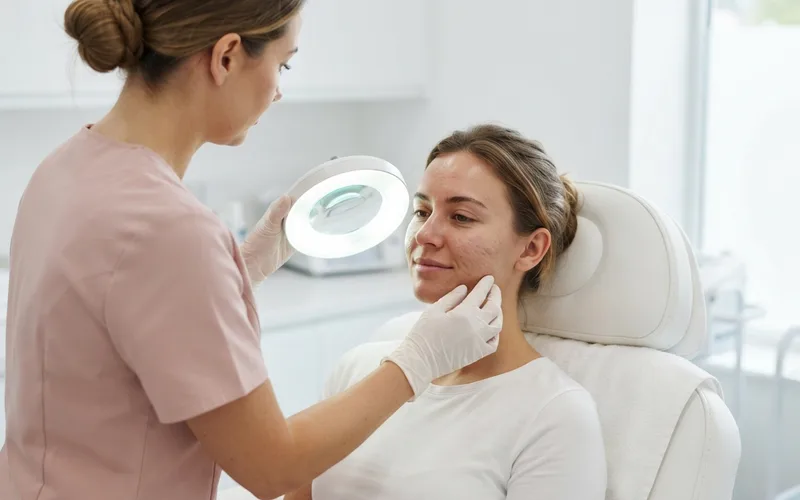
The short answer: the best treatment for spot scars depends on what kind of scar you have. Flat red or brown marks usually fade with peels, PRX-T33, SPF and time. Sunken rolling and shallow boxcar scars often soften with a course of microneedling, while deep ice pick scars usually need medical treatments from a dermatologist. Most people improve a lot; very few see scars disappear completely.
Marks or Scars? Check This First
Many people worried about acne scars actually have marks, which respond faster. Run your finger across the area. If the skin feels smooth and the problem is colour, it is a mark:
- Brown or dark marks (post-inflammatory hyperpigmentation) are extra pigment left after a spot. Common in medium and deeper skin tones.
- Red or purple marks (post-inflammatory erythema) are small blood vessels that stay dilated after inflammation. More common in lighter skin; they usually fade slowly.
If your skin dips, has pits or looks uneven in side lighting, that is scarring: the spot damaged the collagen beneath it and the skin healed with a depression. My guide to dark spots on the face is more useful if your concern is mainly flat discolouration.
The Types of Acne Scar
Rolling scars. Broad, soft-edged dips that make skin look wavy, caused by bands of tissue tethering the skin from below.
Boxcar scars. Round or oval depressions with sharper edges, a bit like chickenpox marks. They range from shallow to deep.
Ice pick scars. Narrow, deep, pinpoint scars, as if the skin has been punctured. The most stubborn type.
Enlarged pores. Not a scar in the strict sense, but years of congestion and inflammation can leave pores looking larger and the skin around them less firm.
Raised scars. Hypertrophic and keloid scars need medical assessment rather than the treatments here.
Most people have a mixture, which is why I assess your skin in good light first.
Which Treatment Suits Which Scar
| Scar or mark | Treatments at my clinic | Options elsewhere (medical clinics) | Honest outlook |
|---|---|---|---|
| Brown marks | Chemical peels, PRX-T33, SPF | Some lasers | Often fade well over a course |
| Red marks | Gentle skincare, SPF, time | Vascular laser | Usually fade gradually |
| Rolling scars | Microneedling | Subcision, fillers | Can soften noticeably |
| Shallow boxcar | Microneedling, chemical peels | Fractional laser | Can improve; depth matters |
| Deep boxcar and ice pick | Limited help on their own | TCA CROSS, punch excision, laser | Best assessed by a dermatologist |
| Enlarged pores | Peels, microneedling, PRX-T33 | Some lasers | Can look smaller, never closed |
I do not offer lasers, subcision or injectables, but they are genuine options for some scars, and I will tell you if you need one.
Microneedling for acne scars
Microneedling is the treatment I most often suggest for rolling and shallow boxcar scars. Fine needles create tiny channels in the skin, which starts a healing response and new collagen production. Over a course, that collagen can help lift sunken scars so they catch the light less. More detail is on my microneedling in Dunstable page.
Chemical peels for acne scars
A chemical peel removes the outer layers of skin in a controlled way. Peels are particularly good for the brown marks that often sit alongside scarring, for congestion, and for very shallow texture. I often pair them with microneedling for deeper texture. See my chemical peels in Dunstable page and my chemical peel before and after guide.
PRX-T33
PRX-T33 is a needle-free treatment that stimulates renewal with little visible peeling. It suits mild texture, marks and dullness, and people who would rather avoid needles. My PRX-T33 explained post covers how it works.
Open Pores and Large Pores Treatment
Pores cannot be closed, whatever a product label says. What we can do is keep them clear and firm the skin around them: regular peels or a salicylic acid routine for congestion, microneedling to support collagen, and daily SPF. Expect smoother, more even skin rather than invisible pores.
Want an Honest View of Your Scarring?
Book a free consultation in Dunstable. I will look at your skin in good light, tell you which scars and marks you have, and suggest a realistic plan, including if you would be better seeing a dermatologist.
Can You Actually Fix Acne Scars?
You can usually improve them, often a lot. Can you 100% remove acne scars? Rarely. Flat marks can fade completely, but a true scar is a change in the structure of the skin, and treatments soften it rather than rebuild perfect skin. Results mean scars that are shallower and less noticeable in daylight. Anyone promising complete removal is overselling.
How to Fade Acne Scars Fast
Speed depends on what you are treating:
- Flat dark marks fade fastest: daily SPF 30 or higher, no picking and a gentle brightening routine often show change in six to twelve weeks, and peels or PRX-T33 can speed this up.
- Sunken scars cannot be rushed, because collagen takes months to form.
How Do I Remove Acne Scars Naturally?
What home care can do: help marks fade, keep pores clear and protect your results. Useful steps are daily SPF, a gentle cleanser, an exfoliating acid such as salicylic or glycolic acid a few times a week, and a retinoid if your skin tolerates it (not in pregnancy).
What it cannot do: lift rolling, boxcar or ice pick scars. No cream reaches deep enough to rebuild that collagen.
What to avoid: lemon juice, baking soda, toothpaste and harsh scrubs. They irritate skin and can make dark marks worse, particularly in deeper skin tones.
Active Acne Comes First
I will not microneedle over active breakouts. Needling inflamed spots can spread bacteria and create new marks. If you have moderate to severe acne, painful cysts or breakouts that leave new marks every month, please see your GP or a dermatologist first about prescribed treatment.
A few other points:
- If you are taking or have recently finished isotretinoin, you will need to wait before microneedling or stronger peels. Your prescriber can advise on timing.
- SPF is essential throughout, because healing skin marks easily.
Courses and Timelines
| Stage | What usually happens |
|---|---|
| Weeks 0 to 6 | Active acne calmed, home routine settled, first peel or PRX-T33 for marks if needed |
| Session 1 | First microneedling; redness for a day or two |
| Every 4 to 6 weeks | Further sessions, usually four to six in total for scarring |
| Months 3 to 6 | Texture and marks visibly better; scars gradually softer |
| 3 months after the last session | Collagen keeps maturing, so results continue to build |
My microneedling before and after guide shows how results build, and my microneedling aftercare guide covers the days after each session.
Acne Scar Treatment in Dunstable
I see clients from Dunstable, Houghton Regis, Luton, Leighton Buzzard and across Bedfordshire and Hertfordshire. Every booking includes a free consultation, and current prices for microneedling, peels and PRX-T33 are on the treatments page.
Frequently Asked Questions
What is the best treatment for acne scars?
There is no single best treatment because it depends on the scar type. Rolling and shallow boxcar scars often respond well to a course of microneedling, flat brown marks to chemical peels or PRX-T33, and deep ice pick or boxcar scars usually need medical treatments such as subcision, TCA CROSS or laser from a dermatologist.
Can you 100% remove acne scars?
Rarely. Flat red and brown marks can fade completely, but true scars that change the surface of the skin can usually be softened rather than erased. A realistic goal is a clear improvement in how much the scars catch the light, often enough that make-up and photos stop being a worry.
How can I fade acne scars fast?
Flat dark marks fade fastest with daily SPF, no picking and a gentle exfoliating or brightening routine, often with visible change in six to twelve weeks. Sunken scars cannot be fast-tracked, because rebuilding collagen takes months, so a course of microneedling is measured in months rather than weeks.
Can I remove acne scars naturally at home?
Home care can help flat marks fade and keep skin healthy, using SPF every day, a gentle exfoliating acid and a retinoid if your skin tolerates it. It cannot lift sunken rolling, boxcar or ice pick scars. Lemon juice, baking soda and harsh scrubs tend to irritate skin and can make marks darker.
Can I treat acne scars while I still have spots?
Active acne needs to be calmed first. Microneedling over inflamed spots can spread bacteria and worsen inflammation. If you have moderate to severe acne or regular painful breakouts, see your GP or a dermatologist about prescribed treatment before starting scar work.
What is the best treatment for open or large pores?
Pores cannot be closed, but they can look smaller. Regular chemical peels and a salicylic acid routine help keep them clear, and a course of microneedling can firm the skin around them so they look tighter. Daily SPF matters too, because sun damage loosens the skin that supports pores.