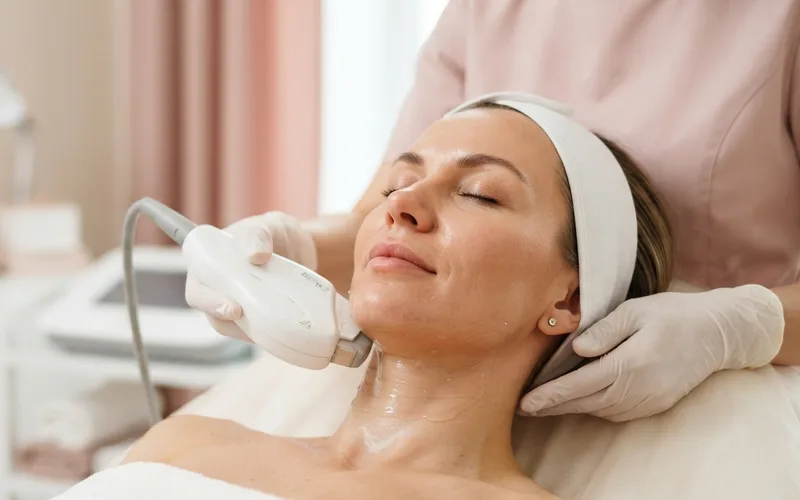
HIFU usually takes 8 to 12 weeks to show, and reaches its best between three and six months after one session. For people with mild to moderate sagging along the jaw, under the chin or at the brow, the before and after difference is real but natural: a crisper jawline and firmer skin, not a surgical facelift. Results commonly last 12 to 18 months.
That is the short answer. Below is what I explain to clients in my Dunstable clinic, including the downsides and what happens when HIFU goes wrong.
How HIFU Produces a Result
HIFU, or high intensity focused ultrasound, sends focused energy to set depths beneath the skin without breaking the surface. At each focal point the tissue is heated in a tiny, controlled zone, which tightens existing collagen and prompts your body to build new collagen over the following months.
On a clinical grade device such as the 360MAX 22D that I use, those depths include the SMAS, the firm layer a surgeon would lift in a facelift. That is why HIFU can lift rather than only improve the surface. My guide to what HIFU is covers the science in more detail, and you can see treatment options on my HIFU in Dunstable page.
How Long After HIFU Will I See Results?
| Stage | What you are likely to notice |
|---|---|
| Straight after | A slight tightening and fresher look, partly mild swelling; skin may be pink or tender |
| Days 1 to 3 | Redness and tenderness settle; some swelling fades |
| Around 4 weeks | A quiet stage: collagen is forming but little is visible yet |
| Around 8 to 12 weeks | Changes become noticeable: a crisper jaw, firmer under the chin |
| 3 to 6 months | Usually the best result, and the fairest time for an "after" photo |
| 12 to 18 months | Results gradually soften as natural ageing carries on; many choose a top-up |
Please do not judge HIFU at four weeks. My guide to how long HIFU results last explains how long they hold and when a top-up makes sense.
Does HIFU Really Work for Jowls?
Often, yes, if the jowling is early to moderate. The lower face and jawline are where HIFU tends to show most clearly, because the SMAS there responds well to lifting. If skin is heavy and overhanging, HIFU will soften rather than remove it, and I will tell you so. My guide to jowls treatment without surgery goes into more detail.
Is HIFU Actually Worth It?
For the right person, yes. It is usually a single session, has little downtime and gives a natural lift that builds gradually. It is less worthwhile if you expect surgical results, have very significant loose skin, or your main concern is on the surface, such as pigmentation or acne scarring, where a peel or microneedling is a better fit.
HIFU suits you if you have mild to moderate laxity along the jaw, neck, chin or brow and want a subtle, natural lift without surgery.
It may not suit you if you want an instant transformation, have heavy, overhanging skin, or are very slim in the face with little natural volume, which I discuss below.
What Are the Downsides of HIFU?
- Results are gradual and not guaranteed; a small number of people see only a modest change.
- It is uncomfortable while the pulses are delivered, especially over bone.
- Temporary redness, swelling, tenderness or numbness can occur. My article on HIFU side effects covers what is normal.
- It needs repeating to maintain results.
Wondering How HIFU Would Work for You?
Book a free consultation at my Dunstable clinic. I will assess your skin honestly and tell you whether HIFU is likely to give you a result you are happy with.
HIFU Gone Wrong: What Can Happen and Why
Most HIFU treatments go smoothly, but searches for "HIFU gone wrong" exist for a reason. The problems people describe usually include:
- Burns or blisters, sometimes leaving lines or marks on the skin
- Nerve irritation, causing numbness, tingling or a temporarily uneven smile
- Prolonged swelling, bruising or tender lumps
- Unwanted fat loss, leaving the cheeks or temples looking hollow
These are rarely random. They usually come down to:
- Untrained or poorly trained operators who do not understand facial anatomy or where nerves run
- Cheap or unregulated devices with inaccurate depths or energy output
- Wrong depth selection, for example using a deep cartridge over thin skin or bony areas
- Too many passes or too much energy in one area
My guide HIFU vs cheap HIFU explains why bargain treatments carry more risk, and is HIFU safe covers who should not have it.
How to choose a safe HIFU clinic
- Ask about the practitioner's training. I hold a VTCT Level 4 qualification in HIFU.
- Ask which device is used and whether it is a clinical grade machine.
- Expect a proper consultation and medical history before any treatment.
- Be wary of very low prices, rushed appointments or promises of dramatic results.
- Ask to see the clinic's own client photos, not manufacturer images.
Can HIFU Make You Look Older?
This worry usually comes from fat loss. HIFU heats tissue, and if the deeper cartridges are used over areas where your face relies on fat for fullness, such as the mid cheeks or temples, it can reduce that volume and leave the face looking hollow or drawn. That is a technique problem, not an inevitable result. A careful practitioner maps your face, chooses depths for each zone, uses fat reduction depths only where they help (such as under the chin) and avoids over treating already slim faces. If your face is very lean, I may suggest treating fewer areas, or not treating at all.
What Is Better, Botox or HIFU?
They do different jobs. Botox relaxes the muscles that cause expression lines such as frown lines and crow's feet. HIFU lifts and firms sagging tissue along the jaw, neck and brow. Neither replaces the other. I do not offer Botox or any injectables at Amina Beauty; if expression lines are your main concern, a medical aesthetics practitioner is the right person to ask.
How to Judge HIFU Before and After Photos
- Same lighting. Overhead light deepens jaw shadows; soft front light flatters.
- Same angle. Tilting the chin up a few degrees can make a jawline look dramatically sharper.
- Same expression. A relaxed face and a smile change the lower face a lot.
- Realistic timing. Same day photos show swelling; three to six months shows the true result.
- Real clients. Check the photos are of that clinic's clients, not stock images.
Clients visit from Dunstable, Luton, Leighton Buzzard and across Bedfordshire and Hertfordshire. Full prices are on my treatments page.
Frequently Asked Questions
How long does HIFU take to work?
You may notice a slight tightening straight away, but the real result comes from new collagen. Most people start to see a change at around 8 to 12 weeks, with results usually at their best between three and six months after treatment.
Is one HIFU session enough?
For many people with mild to moderate laxity, one session gives a visible result. Some people with more laxity benefit from a second session, and most choose a top-up every 12 to 18 months to keep pace with natural ageing. I will tell you honestly at consultation what is realistic for you.
Does HIFU work on the jawline?
The jawline is one of the areas where HIFU tends to show most clearly, because the energy reaches the SMAS layer that supports the lower face. Early jowling and a softening jaw edge often respond well. Heavy, overhanging skin is usually beyond what HIFU can correct.
How long do HIFU results last?
Results commonly last around 12 to 18 months. Your face keeps ageing naturally, so the treated area slowly returns towards where it would have been, and many people choose a yearly top-up session.
Does HIFU hurt?
Most people feel warm, prickly pulses that are strongest over bony areas such as the jawline and forehead. It is uncomfortable rather than painful for most clients, and I adjust the settings and pace so you stay comfortable. No numbing cream is needed.
How much does HIFU cost at Amina Beauty?
A Full Face Lift is £399, Face and Neck Lift £489, Jawline Sculpt and Lift £289, Lower Face £329, Double Chin Reduction £299 and Non-Surgical Brow Lift £159. Every booking includes a free consultation.